Your First Kruger Safari? Here's the Wildlife Photography Gear You Actually Need, and it's not what you think


There are few places on Earth quite like the Kruger National Park. Every sunrise brings the possibility of spotting lions on a hunt, elephants crossing the road, or a leopard lounging in a marula tree. It's one of the world's greatest wildlife destinations, and for photographers, it's paradise.
But capturing those unforgettable moments takes more than simply pointing a camera out of the window.
After spending time photographing wildlife throughout Kruger, I realised that success has very little to do with owning the most expensive camera or the sharpest lens. Instead, it's about being prepared, keeping your setup simple, understanding your camera, and focusing on the wildlife rather than your equipment.
Whether you're visiting for the first time or you're returning for another safari adventure, here's everything I've learned that helped make my Kruger photography trip a massive success.
Keep Your Setup Simple
One of the biggest mistakes first-time visitors make is bringing every lens they own. While it might seem like you'll need every focal length imaginable, constantly changing lenses or deciding which one to use often means missing the moment entirely.
My advice is simple: keep your setup as uncomplicated as possible.
If you only have one camera body, pair it with the most versatile lens you own and leave it attached for most of the day. If you're fortunate enough to own two camera bodies, dedicate one to a wider lens such as a 24–70mm and the other to a telephoto like a 100–400mm or longer. That combination is more than enough for almost every wildlife sighting you'll encounter.
When a fish eagle suddenly lands on a dead tree or a leopard steps out of the bush for only a few seconds, you don't want to be digging through your camera bag wondering which lens would be best. Grab the camera that's already in your hands and start shooting.
Remember, you'll spend almost your entire safari inside your vehicle, so carrying a second camera body isn't much of a burden. Keep one lens on each camera, avoid changing lenses in dusty conditions, and spend your time watching the wildlife instead of worrying about your equipment. The best wildlife photographers aren't constantly changing gear—they're simply ready when the moment happens.
Dust Is Your Biggest Enemy
Kruger roads can become incredibly dusty, especially during the dry season, and that dust has a habit of finding its way into every piece of camera equipment you own.
Try to avoid changing lenses whenever possible. Every time you remove a lens, tiny particles have the chance to settle inside your camera body and eventually onto the sensor.
Whenever you're not actively photographing, place your camera back inside your bag to protect it from dust. Always keep both lens caps with you, and before cleaning your lens, use a blower to remove loose dust so you don't accidentally scratch the glass. A quality microfiber cloth is all you need to finish the job.
At the end of each day, spend a few minutes wiping down your equipment before packing it away. That small habit can save hours of sensor cleaning later.
How to Shoot Through Your Car Window
One of the biggest mistakes new visitors make is trying to handhold a heavy telephoto lens through the car window. At longer focal lengths, even the smallest movement becomes noticeable.
Instead, rest your lens on a bean bag placed over the open window frame. It creates an incredibly stable platform while still allowing you to react quickly when an animal changes direction. If you don't own a bean bag, a simple pillowcase filled with rice or beans works surprisingly well.
Another tip that's often overlooked is switching your engine off whenever it's safe to do so. Even tiny vibrations from an idling vehicle can soften an otherwise perfect photograph.

My Personal Kruger Setup that worked for me
After several days photographing wildlife in Kruger National Park, I realised something important: the best setup isn't always the sharpest or the most expensive. It's the one that lets you capture the moment without thinking.
For my trip, I used a Fujifilm X-H2 paired with a Tamron 18–300mm lens. On the APS-C sensor, that gives me an effective field of view of roughly 27–450mm in full-frame terms.
Is it the sharpest lens available? No. Can it fully resolve the X-H2's 40-megapixel sensor? Probably not. Did it matter? Not really.
What mattered was having one lens that could do almost everything. If an elephant walked right alongside the road, I simply zoomed out and included the surrounding landscape. When a lilac-breasted roller landed on a branch in the distance, I zoomed in. There was no panic, no lens changes, and no second-guessing my equipment.
That simple setup allowed me to focus entirely on the wildlife, the light and the experience unfolding around me. Looking back at my trip, I don't remember wishing I'd packed a sharper lens. I remember the incredible sightings I was able to photograph because my camera was always ready.
Sometimes the best wildlife setup isn't the one with the highest image quality on paper—it's the one that allows you to stay immersed in the moment.
Camera Settings That Work
Wildlife rarely waits for photographers. A lion can suddenly stand up, an eagle can launch into flight, or a herd of impalas can explode into a sprint within seconds.
As a starting point, I recommend keeping your shutter speed around 1/1000 of a second or faster for most wildlife, increasing it to around 1/2000 of a second when photographing birds in flight or particularly fast action. I generally like shooting between f/2.8 and f/4 to separate the subject from the background while letting in as much light as possible. Continuous autofocus, burst shooting, and Auto ISO complete a setup that's always ready when something exciting happens.
Don't Be Afraid of High ISO
One of the biggest mistakes new wildlife photographers make is trying to keep their ISO as low as possible.
A low ISO certainly produces cleaner images, but it also forces your shutter speed to become slower. In Kruger, that often means missed opportunities.
Birds take flight without warning. Impalas sprint across the road. Lions begin chasing prey. Elephants throw dust into the air. Wildlife moves quickly, and your shutter speed should always be your priority.
Don't be afraid to increase your ISO to 1600, 3200, or even higher when the light starts fading. Modern cameras handle high ISO remarkably well, and today's editing software can remove an impressive amount of noise. Motion blur, however, is almost impossible to fix.
I'd much rather come home with a sharp photograph that has a little grain than a perfectly clean photograph that's blurred beyond repair. If you remember one camera tip from this entire article, let it be this one.
Tell the Story, Not Just the Animal
It's tempting to zoom in as far as your lens allows. After all, that's why we buy telephoto lenses.
But don't forget to zoom back out.
Some of my favourite photographs from Kruger aren't close-ups at all. They're images that show the animal within its environment.
A lone elephant walking through endless mopane woodland. A zebra quietly grazing in golden grass. A giraffe silhouetted against a dramatic African sunset. A lion sitting proudly on a rocky outcrop overlooking the vast African savanna.
Those photographs tell the story of Kruger.
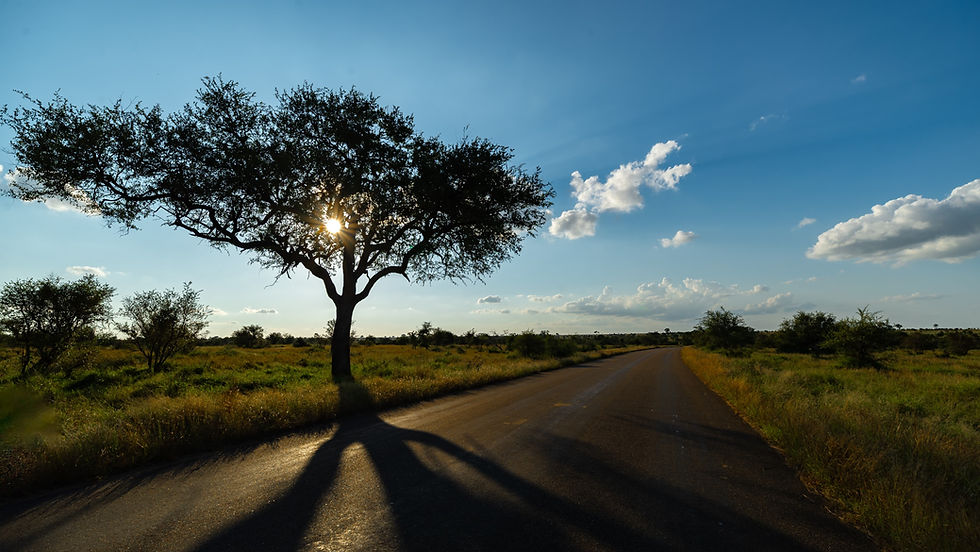
Coming from a landscape photography background, I've found myself drawn more and more towards environmental wildlife photography. Instead of filling the frame with a lion's eye, I want to show the landscape that lion calls home. The sweeping skies, the open grasslands, the distant hills and the feeling of being there are just as important as the animal itself.
Of course, close-up portraits still have their place. The key is creating a collection of images that captures both the wildlife and the incredible world they live in.

Respect the Wildlife
Every great wildlife photographer understands one simple rule: the animal always comes first.
Never lean out of your vehicle, never feed wildlife, and never try to attract an animal's attention by making noises. Be patient and allow nature to unfold at its own pace. Some of the most rewarding photographs come after quietly waiting several minutes for an animal to behave naturally.
Don't Forget to Enjoy the Moment
It's surprisingly easy to spend your entire safari looking through a viewfinder.
Every now and then, lower your camera. Listen to the birds, watch elephants interacting with one another, enjoy the sunrise, and simply appreciate where you are.
Some memories are too special to experience only through a camera.
Final Thoughts
When I arrived in Kruger, I thought the secret to great wildlife photography would be expensive lenses and the perfect camera setup.
By the time I left, I'd learned something completely different.
Being prepared matters far more than owning the sharpest lens. A simple setup, confidence in your camera settings, the willingness to use higher ISO values, and the ability to tell a story rather than simply photograph an animal will make a far bigger difference than any piece of equipment.
Most importantly, remember why you're there.
You're not just photographing lions, elephants, birds and leopards. You're photographing one of the greatest wildernesses on Earth.
Slow down. Observe carefully. Respect the wildlife. Enjoy the experience.
The photographs will follow.

